

The question an intelligent skeptic would ask
“Isn’t this solved already? If two systems can call each other through APIs, share a schema, and pass security review, what exactly is left? Why add philosophical baggage—meaning, obligations, authorized change rules—to something that is basically integration engineering?”
It’s a fair challenge, because the industry has trained leaders to treat “interoperability” as a plumbing milestone: endpoints are reachable, events flow, dashboards light up, and the program is declared a success.
The trouble is that organizations rarely fail at connectivity. They fail at composition—the moment when outputs from one governed context become inputs to another, and the implications of the output no longer survive the journey.
First-pass answer
APIs can move data. Intelligence interoperability must move data plus what the data means plus what the data obligates you to do or not do.
A quick way to see the gap:
API interoperability answers: Can system A call system B and exchange fields reliably?
Intelligence interoperability answers: If system A’s output triggers a decision in system B, do the same meanings, constraints, and rollback rights still hold after composition?
If the answer is “no,” your integration is not a bridge. It is a scaled incoherence generator: you propagate information while silently dropping the obligations that made the information legitimate.
Deeper answer
In our new intelligence framing, a TDI is not a token in the casual sense. It is a governance-capable recursion: a transportable encoding of learning and decision capacity that stays inspectable and reversible under change. In other words: it is designed to travel without losing its ethical and operational binding.
That’s exactly what “interoperability beyond APIs” demands: composition where the rules of legitimacy survive the seam.
Two structural intuitions matter here—expressed managerially:
(a) “Integration breaks when routes to the ‘same’ decision don’t agree.”
Imagine two paths to the same downstream action:
Path 1: Supplier → Catena-X shared data space → OEM compliance workflow
Path 2: Supplier → bilateral portal upload → OEM compliance workflow
If these routes yield different eligibility, liability exposure, audit traces, or consent status, then the seam is non-commuting in practical terms: “same” input, different implications. That is not a data issue; it is a structure-preservation failure.
(b) “Meaning and obligation must be able to glue across overlaps; change must be authorized across seams.”
Sheaf + gauge rails offer a disciplined way to state the requirement:
Sheaf requirement (gluing): obligations, consents, claims, and normative constraints must remain coherent when contexts overlap (multi-tier supply chains, joint workflows, shared analytics). Where they can’t glue, you don’t hand-wave—you log an obstruction and repair it.
Gauge requirement (authorized change): updates are not “whatever the integration team ships.” They are transformations that preserve declared invariants and support rollback. If one party can “update semantics” while another treats semantics as fixed, you have cross-enterprise drift baked in.
So the heart of Week 33 is a simple claim with sharp teeth:
A pipeline that moves data without moving obligations is not integration; it is scaled incoherence.
Objections and replies
Objection 1: “We already have governance—security, privacy, compliance. Isn’t that the obligation layer?”
Reply: most governance is intra-enterprise and document-centric. It lives in policies, training decks, risk registers, and legal clauses—not in the traveling unit of intelligence itself. Intelligence interoperability requires obligations to be computable, testable, and auditable at the seam—the point where your control is weakest and your liability is most entangled.
Objection 2: “Semantics is endless debate. We can’t ‘solve meaning.’”
Reply: you don’t need metaphysical perfection. You need operational semantics: acceptable evidence types, transformation rules, and explicit ambiguity handling. In practice, the goal is not “one true meaning,” but meaning that is stable enough to govern decisions, and explicit enough to detect when two routes stop agreeing.
Objection 3: “This will slow integration. We need speed.”
Reply: API-only speed is often borrowed time. It accelerates launch while deferring the expensive part—repairing incoherence after it has multiplied across partners, workflows, and models. The fastest path to durable speed is to standardize the seam artifact so each new integration is not a reinvention of legitimacy.
What changes if you buy this (before vs after)
Before (API-centric integration):
Success looks like “end-to-end data flow.”
Semantics are assumed or embedded in tribal knowledge.
Obligations live in PDFs and meeting notes.
Cross-company AI is a gamble: impressive demos, fragile legitimacy.
After (intelligence interoperability):
Success looks like “meaning preserved, obligations enforced, updates authorized across the seam.”
Seams become governance objects with explicit tests.
TDIs (or TDI-like learning encodings) can circulate across Catena-X without losing the constraints that make them safe to act on.
Co-creation becomes practical: engineers, quality teams, compliance, and AI systems collaborate on shared data spaces where legitimacy is designed, not assumed.
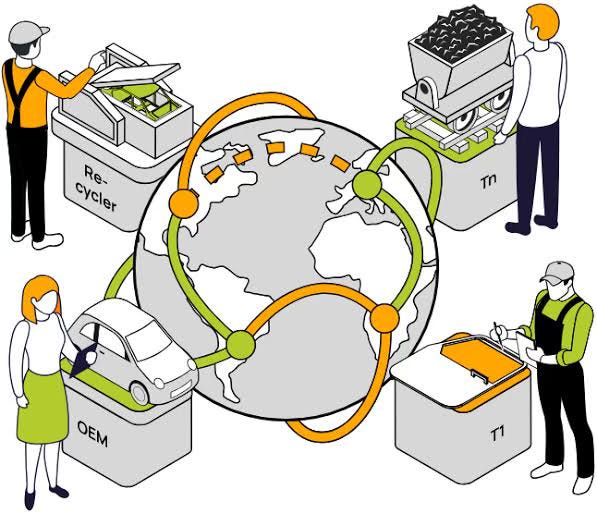
A concrete Catena-X illustration makes the shift tangible:
In a battery-passport workflow, a Tier-2 supplier provides lifecycle data. The OEM’s compliance decision depends not only on the values, but on how those values were produced, what transformation rules were applied, what retention/expiry constraints apply, and what audit trace must be preserved.
If that obligation bundle drops at the seam, the OEM may still compute a footprint—but cannot defend it under regulatory scrutiny, nor safely automate any decision that depends on it.
Examples from a variety of contexts show this is not “automotive-specific”:
SAP’s embedded agents can execute actions inside core workflows. The risk is not that an agent calls the wrong API. The risk is that the agent crosses from one obligation regime to another (HR, procurement, finance) without carrying the decision rights and audit semantics that make the action legitimate.
Databricks/Snowflake-style data-to-AI platforms excel at producing outputs quickly. But without obligation transport, “governed data” becomes “ungoverned action”—especially once retrieval-augmented and agentic systems start writing back into operational systems.
India Stack / DPI logic demonstrates the architectural point: population-scale interoperability works when identity, consent, and trust are treated as first-class rails—not optional paperwork stapled on later.
OpenAgriNet adds the ecosystem lesson: “network of networks” only scales when local context and constraints can be honored while still enabling cross-system composition.
One-page crib for explaining it to others
Definition:
API interoperability = systems can exchange data reliably.
Intelligence interoperability = after composition, meaning, obligations, and authorized update rules still hold—so decisions remain legitimate and reversible.
Three seam diagnostics:
Two-route test: if the same downstream decision is reached via two integration paths, do we get the same implications (rights, duties, auditability, allowed actions)?
Gluing test: when contexts overlap (multi-tier partners, shared analytics), do obligations remain coherent—or do we see conflicts that must be repaired?
Update authorization test: when schemas/semantics change, do all parties share the same update classes and rollback rights?
Red flags:
“We’ll document semantics later.”
“Compliance signed off once, so we’re good.”
“The model is aligned; integration is just wiring.”
“Partners can map fields however they want.”
If you can’t transport obligations, you can’t compose intelligence—only signals.