

The recurring problem patterns (and the plays that break them)
Pattern 1 — “We funded AI. Why did the system get harder to run?”
Symptom: delivery is on track; exceptions and escalations rise; frontline work thickens.
Play: Assemblage Quick-Map to identify the edges where decision travel and friction concentrate.
Pattern 2 — “The dashboard says green, but trust says red.”
Symptom: model metrics improve; people still don’t rely on the system; informal workarounds spread.
Play: Edge-level accountability surfaces (who approves/overrides/audits) plus one enforceable evidence rule.
Pattern 3 — “Risk didn’t disappear; it moved.”
Symptom: failures are consistently absorbed by one group (often frontline, compliance, or customer service).
Play: Risk displacement tagging on edges, then redesign one edge so the burden is explicit, shared, and governable.
Pattern 4 — “We keep arguing about what’s inside the system.”
Symptom: repeated boundary disputes; unclear ownership; perpetual ‘someone else’ explanations.
Play: Boundary sentence + regulator/risk node requirement in the map.
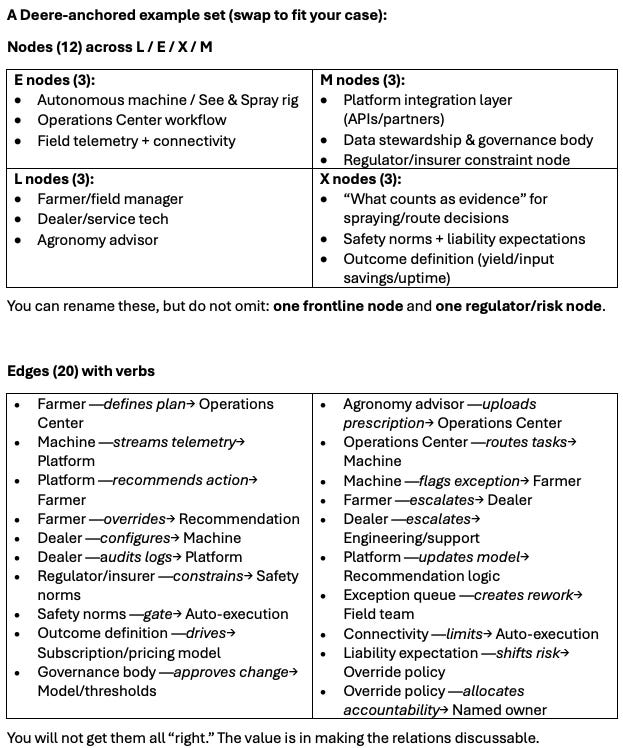
Artifact: Assemblage Quick-Map (12 nodes / 20 edges)
Rule: keep it small enough to complete in an hour, rich enough to be truthful.
Nodes (12) across L / E / X / M
Use MLXE shorthand, without turning it into theory-talk:
L (virtual-real): lived roles, trust, identity stakes
E (actual-real): operational flows, execution, telemetry
X (virtual-possible): commitments, meanings, “what counts,” legitimacy
M (actual-possible): infrastructures, interfaces, architectures, scalable capabilities
Edges (20) with verbs
Write edges as “A —verb→ B.”
How to run it (45–60 minutes)
Step 1 (5 min): Choose one decision that matters.
Examples: exception approval, safety gating, replenishment routing, autonomous execution thresholds.
Step 2 (10–15 min): Place 12 nodes.
Enforce the two constraints: include one regulator/risk node and one frontline node.
Step 3 (15–20 min): Draw 20 edges with verbs.
If you stall, ask: How does information move? How does authority move? How does accountability move?
Step 4 (10 min): Circle the 3 edges with the highest friction/risk displacement.
Use fast markers:
Friction: rework loops, escalations, exception piles
Risk displacement: one group repeatedly absorbs failure
Intensity: speed pressure, liability, convenience, status cliffs
Three-edge intervention discipline (the heart of the playbook)
For each of the three circled edges, write three lines—no more.
Expected ripple effects
“What else will move if we change this edge?”
(Interfaces rarely change alone; they propagate.)New accountability surface
“Who becomes answerable for outcomes produced by this new coupling?”Confirming signal (improvement vs drift)
“What signal, visible within two weeks, tells us we improved rather than merely shifted pain?”
A useful constraint: treat each edge change as a governance move, not merely a process tweak. Creative Transformation of Organizational Ecosystems’ point that organizational agency is an emergent effect of relational dynamics is not abstract philosophy—it is a warning about where responsibility actually lives.
Early instrument-panel signals (Week 3)
Track these lightly for two weeks:
Friction intensity: rework/escalation concentrates on one edge
Risk displacement: failures consistently absorbed by one group
Boundary confusion: repeated disputes about “what’s inside the system”
Override heat: overrides rise without shared reasoning (a legitimacy smell)
Exception aging: exceptions linger (governance latency)
Embedding into existing rituals (so it doesn’t become theater)
Add the one-sentence unit test to every steering committee memo.
Replace “initiative status” with “edge status” for the top three edges.
Require an accountability surface line item for any automation proposal.
Treat boundary disputes as system design debt, not interpersonal conflict.
Output checklist (end of Week 3)
You finish Week 3 when you have:
A one-page assemblage map (12 nodes / 20 edges)
A three-edge intervention plan (ripple effects, accountability surface, confirming signal for each)
A named owner for the next seam test (Week 4)
Once the assemblage is named, transformation becomes governable. Without it, you are left with activity, slogans, and hope.